| xx |
| cc |
| www.fretnotgospel.com/nigeria.html |
| cc |
| by Noah Arthur |
| References - Books Cultures of the World - Nigeria, Erin Pembrey Swan, Childrens Press, Chicago, 2002 Internet Indonesia: History, Geography, Government, and Culture, Infoplease.com, 05/22/07 Popular Entertainment and Islam in Indonesia, Wall Street Journal, April 2007 |
| by Noah Arthur |
| Nigeria |
| FIRST IMPORTANT THING ABOUT NIGERIA: Nigeria is made up of many different people groups. One of the main issues in Nigeria is conflict between different people groups, called "ethnic conflict". There are at least a hundred different tribes in Nigeria, each occupying an area of the country and overlapping on the outer edges. Tribes in Nigeria are not like the tribes in southern Africa, because they no longer have tribal war. Most people in the north are in the Fulani and Hausa groups. The Hausa people are generally wealthier and hire many Fulani people to work for them. The Hausa language is the most commonly spoken language in northern Nigeria. The Fulani that do not work for the Hausa are milk-producers, following rains in the desert to give their cows good grazing. The northern Hausa and Fulani areas are the most prosperous and well-educated part of Nigeria. The Tiv people of central Nigeria once had no leaders at all, just living together in their villages without anyone in charge. Now they recognise the Nigerian government as a leader, but still have none of their own. Their language is a south African type language. The Yoruba are one of the main people groups of the rainforested southwestern area. They once lived in villages with a very powerful rich ruler in a palace in the middle of the town. Now, the "powerful" part has shrunk and the "rich" part has grown. Yoruba people commute each morning to work on their farms outside of town. Ibo people were once the richest and most powerful of all Nigerians, especially during the British slave trade. They had all of the high governmental positions and were the main slave dealers. Their original home was in the eastern region of Nigeria, and this is where they now live. Just after the slave trade, Ibo people in the north were killed off by angry Fulanis and Hausas who were jealous of the Ibos' governmental power. After this, most Ibos moved back to the eastern area. They failed to keep Biafra, a country of their own that they set up. |
| Country of the Month |
| by Noah Arthur |
| by Noah Arthur |
| by Noah Arthur |
| r |
| by Noah Arthur |
| by Noah Arthur |
| Food Nigerian food is mainly made up of rice-type and yam-type foods. There is corn, guineacorn, yams, cocoyams, rice, and others. Beef is the most commom meat, but no meat is eaten often. Other kinds include chicken and goat. There is one particular yam dish that sounds good to me. It is a loaf of yam mush, and people take a piece off, mold it into a spoon shape, and dip it in a sauce before eating the bite. Fruit is the main dessert item in Nigeria. In the rain forest, there is abundant tropical fruit such as plantains ("dodo") and bananas. Other desserts include sugary pastries. Drinks include palm wine, and palm products are often used in cooking. Peanut oil is another common cooking oil. Most Nigerians eat with their fingers, although rich city people usually eat with silverware or plasticware. In some families, the oldest family members are served first, and the younger members eat what the older ones do not eat. My Experience at a Nigerian Restaurant: At a Nigerian restaurant in Oakland, California, U.S.A., I had fried plantains called "dodo", goat, and rice with a red sauce, all on one dish. The dodo was sweet and juicy, the goat was good, having a light, gamey taste, and the rice with red sauce was also good, but it was not very different from other rice dishes I have had before and since. Economy Oil is Nigeria's main product. The oil industry is at $15 billion a year, but it is not necessarily a good thing. In the Niger Delta, it has ruined all natural habitat, along with the lives of the people of a local tribe. This has resulted in fights and kidnapping between oil workers and that tribe. Nigeria has more oil potential than Iraq, but its government is too corrupt to fully use it. Besides oil, there are many other products made in Nigeria. These include traditionally patterned textiles, the cotton fabric of which is produced in northern Nigeria rather than being imported. The textiles are mainly sold to tourists, along with traditionally patterned pottery. Other products include palm oil, which took the place of slaves as Nigeria's main product before real oil was found. |
| Art and Music Nigerian art has been greatly influenced by Europe, and there is now little traditional art existing in Nigeria. Now, any traditional art is made, with modern supplies, for tourists. Like many parts of Nigerian culture, traditional art is fading away. Most early Nigerian art was in the form of sculptures and statues. The earliest known Nigerian sculptures were made by the Nok people of the Jos Plateau. They were scarecrows made to protect crops against birds. The first truly artistic sculptures were from Benin and were mainly bronze heads. Many of the Nigerian musical instruments are drums. These vary from the skinless slit drum to the Yoruba tension drum that sounds like a voice speaking Yoruba. There is a similar tension drum that sounds like Hausa language. Besides drums, there are thumb pianos, one-stringed guitars, and others. Nigerian music also includes singing. There are many traditional dances still performed at festivals, but most of the old war dances and others are forgotten. Some involved elaborate head dresses, necklaces, and multicolored strings draped over the upper body. War dances were less elaborate, without the strings. |
| Laguage There are hundreds of different languages in Nigeria. Each people group has its own, and there are also European languages such as English. Nigeria's most widely spoken language is probably Hausa. It originally came from northern Nigeria, and is now spoken by many different people groups throughout the country. Some languages are written, while the written forms of some others were worked out by Europeans. An example of this is the Tiv language. It was originally unwritten, and a written form was worked out by Nigeria's first Europeans. The Tiv language is a very interesting one. It has several different noun types, not just male and female like Spanish has. It is similar to South African languages. Yoruba and Ibo are both spoken in the southern areas. There are many different dialects of both, and a Yoruba speaker from Oyo said that he could not understand Yoruba spoken in Lagos. Hausa is northern Nigeria's (and probably all of Nigeria's) most widely spoken language. It is spoken not only by Hausa people byt by Fulani people who live in Hausa settlements. Hausa is a tone language, and "kashi" can mean wet, fight, heap, or poop, depending on the tone. English is another common language, and is taught to all Nigerian schoolchildren as a second language. It was introduced by early Europeans, along with French. It has become blended with some Nigerian languages, resulting in mis-spelled English words in Hausa or Yoruba grammar pattern. information from: Cultures of the World; Nigeria by Erin Swan. |
| by Noah Arthur |
| SECOND IMPORTAN THING ABOUT NIGERIA: Nigeria is ruining its natrual diversity Oil spills have ruined the deltas and fires have killed the mangroves, but the biggest Nigerian environmental problem of all is the rain forest. It once covered southern Nigeria, and was home to forest elephants, striped antelope, hippos, rhinos, and mice. Huge elephants walked and grunted along their underbrush trails, while birds whooped and twittered and male Blue Charaxes butterflies fought fatal battles in canopy air. There were birds of every species imaginable, including Hornbills, Babblers, Weavers, Crowned Eagles, Hawks, Kites, Eagle Owls, Hawk Owls, Fish Owls, Fishing Owls, Teal Ducks Whistling Ducks, Herons, Egrets, Quails, Darterbirds, Bee Eaters, and many others. Now, however, only five percent of the rainforest present in the early 1900's is still in existence. Thousands of animal species not yet known to science have probably gone with it, probably a few spectacular as the forest antelope or elephants. But there is still some hope. If conservation groups work very hard, the loss of species may be preventable. Also, zoos and other African countries have most of the lost Nigerian species. In the savanna north there is some effort going on to preserve species such as Zebras, savanna Elephants, Hippos, Rhinos, savanna Antelope, Gazelles, Lions, Wild Dogs, and many others. Also protected are Hornbills, Weavers, Kites, Pygmy Owls, and migratory Charaxes butterflies. Some of the most remarkable Nigerian animals are the surprisingly humanlike apes. In Nigeria (at the edge of extirpation) live the Gorilla and the Chimpanzee, the two most spectacular ape species. Gorillas are larger than men. Nigeria has a great and beautiful butterfly fauna. Some of these adaptable creatures are not harmed by the clearing of forests, and some take to the city streets easily and happily. Nigerian butterflies include the Euphaedras, with green, pink, purple, and/or yellow undersides and green or purple and orange tops. The African Giant Swallowtail, ten inches across, has brown and orange markings on its narrow wings. Some male Charaxes butterflies have fights to the death with their hard and sharp front wing edges. They can do this because of their speed, going at 16 feet per second. |
| Earlier History: Very long ago, there were people on the Jos Plateau, a high area in central Nigeria. They were the Nok people, and are known for the sculptures they made. A little later on, the Fulani tribe in the north mainly converted to Islam brought by the Arabs. They began a series of "holy wars" called jihads. They fought many different people groups because the other groups were animist, rather than Muslim. There is not much known about the south of Nigeria early on. It is known that the Yoruba were the main power, at least in the rain forest. A Yoruba ruler was chosen by a general agreement of his people that he was the right man for the job. The areas of Oyo and Benin were separate countries at the time, and their armies stayed out of the rain forest because of tsetse flies. The time's most warlike tribes were the Yoruba and Fulani. The people living in the deep forests of Yorubaland in southern Nigeria were constantly troubled by the chance of a raid by the neighboring tribes or even other villages in their own tribe. Such raids included looting and taking slaves. About this time, in the 1700's, the British arrived. They wanted slaves. The habit of the British was to take Africans captive and put them to work in Europe and America as slaves. This, of course, was morally wrong. The captives were first taken in tribal raids, then taken to the nearest British trading post to be sold to the British for a lot of money. Then most of the slaves were shipped to Europe or America. Others were taken to nearby ports to help with the loading and unloading of cargo. This trade was of great monetary benefit to the African slave hunters, most of the Ibo tribe. They turned their tiny villages into great cities with money from the British. With the coming of the slave trade the Yoruba kingdoms in the south crumbled because their people were taken away. Then the British realised that slavery was wrong and began fighting slave traders. Benin was overrun by anti-slavery British soldiers. But their attacks were unsuccessful, and slavery continued in the south. Finally, the Benin capital, Sokoto surrendered to the British When Nigerian wars did not have an effect on the palm oil trade, the British preffered to stay out of them. The British were too troubled by tropical diseases to lose any of their men to war. Eventually, Nigeria, also known as "white man's grave," became independent from the British. They simply could not hold up against tribal war and tropical disease at once. |
| Everyday Life: There is a different kind of lifestyle for each Nigerian people group. The Hausa and Fulani nomadically follow rains in the north, while the Yoruba, in the tropical southwest, have all they need in one place; the rainforest around their villages. There are many complex customs about marriage, birth, and childhood. Some husbands have multiple wives, especially in the Yoruba tribe. Muslim men are allowed to have as many as four, but no more than this, while the Yoruba men can have as many as they want. When a child is born, they are often considered a year old at birth and called "it" until they are named, at a week old. Older children are circumcised at seven years old, and Fulani boys are considered old enough to help with the cows at ten. A person is considered an adult when they marry. Once, having twins in an Ibo village was considered wrong, and a mother with twins was always driven out. A custom in Fulani society is for boys to beat each other to show strength. In small villages, one market place at the center of town sells all that the village people need, while in big cities each market sells only one or two differnt things. Nigerian women mainly do maintenance work around the house. They do things such as repairing ruined things, cleaning, and not going anywhere ever. A woman may see only her husband for days, because she almost never goes out. Women in the north are often subject to "human rights violations". An organization called Womens' Rights Watch Nigeria helps to protect women from this. Religion: Originally, Nigeria was dominated by spirit worship. Each tribe had its own form of spirit worship. Everyday problems were, and still are, often thought to be caused by offending a spirit or ancestor. Good spirits are often called upon to fix everyday problems. Recently, these spirit worship religions have blended with Christianity and Islam, especially the latter. Islam is tied with Christianity as the largest religion in Nigeria. It is highly blended with spirit worship, and practices such as polygamy are now part of Nigeria Islam. There are many mosques in Nigeria, and each has an Emir, or mosque leader. When Muslims pray, they always face towards the "holy city", which is Mecca. Each Muslim tries to make a trip to Mecca at least once in their life. Christianity originally came to Nigeria with missionaries, who came with slave hunters. Because of this association with European oppressors, it was not popular for a long time. It became more accepted when the first African churches opened in Nigeria. These churches were run by Africans, not Europeans. This broke the tie with oppression and Christianity became as widely accepted as spirit worship and Islam. Now, there are several different forms of Christianity. The difference is due to the varying degree of blending with spirit worship. Christians (like me) believe in one God, as three individual persons. |
 |
 |
 |
 |
 |
 |
| Yoruba man dressed up |
 |
 |
 |
| Ibo women dancing |
| Fulani woman |
 |
 |
 |
 |
 |
 |
 |
 |
| Elephant |
| Rhino |
| Euphaedra |
| Bee Eaters |
| Plain Tiger |
| Cymothoe |
| Heron |
| Kite |
| Wild Dog |
| Nymphalid |
| Hippos |
| Chicken |
 |
| Euphaedra |
 |
 |
 |
 |
 |
| crowned crane |
 |
| Blue Charaxes |
| Helmeted Guineafowl |
 |
| cows versus cars |
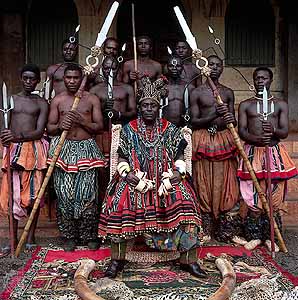 |
| a Bana king |
| dancer |
 |